Dressed for Deception
On Wonder Woman, sex work, deviance and the role of subversion in society

When I was a kid, I always wanted to be a superhero. Actually, I was obsessed with Sailor Moon, so much so that my mum drew me as her, with Afro puffs and a little blue and red sailor outfit. As an only child, I was used to playing games by myself, and there was more freedom in playing alone than with others, I sometimes found. There was no arguing with other children about who got to be who. I was always the heroine, and my imagination could conjure up the villains, too.
In many ways, this fascination followed me into adulthood. The most interesting thing about superheroes is the fact that they blend into society. Superman, Batman, Sailor Moon, Wonder Woman — they all have normal lives that serve as a cover for their supreme reality.
For a lot of sex workers, this is something that feels fairly familiar. Most workers I know conceal their true selves. Even for myself, being very open and public with what I do, I will not necessarily tell people immediately what I do for a living — sometimes not for months of knowing someone. Like superheroes, often seeing us in our work wear is a kind of disguise, if you will.
Yet the same is true of everyone, regardless of what they do for a living. Everybody has hidden desires, driven by parts of themselves they either hold in shame, with acceptance, and very often secrecy. Deviance, as Emile Durkheim first expounded in Rules of Sociological Method in 1895, is an integral part of society. And while deviance is no longer necessarily criminalised, as Durkheim wrote, its role in society is still largely misunderstood or misrepresented.
“Imagine a community of saints in an exemplary and perfect monastery. In it crime as such will be unknown, but faults that appear venial to the ordinary person will arouse the same scandal as does normal crime in ordinary consciences… thus, since there cannot be a society in which individuals do not diverge to some extent from the collective type, it is also inevitable that among these deviations some assume a criminal character. What confers upon them this character is not the intrinsic importance of the acts but the importance which the common consciousness ascribes to them.”
— Emile Durkheim, Rules of the Sociological Method
We often feel like we can know a lot about a person by the clothes they wear. By extension, you can tell a lot about a person by what they don’t wear. For session wrestlers, strippers, escorts, cam girls and other industry persons of our ilk, there is a narrative behind the little bits of lingerie, bikinis or athletic shorts and bras that we choose to clad ourselves in.
Of course, much is made these days about the hypersexualisation of our society. Yet we live in an age of contrasts. If deviance in women is represented by bikinis and booty shorts, what uniform represents hyper-conformity?
It’s an important question, because to be sure of what constitutes a so-called “misbehaviour” demands that we know its equal and opposite. Understanding the roots of social dysfunction requires that we explore what a healthy society actually is — and we can only do that if we embrace, at least for the purposes of academic exploration, what role deviance plays in society. Because deviance does not equal dysfunction — in fact, deviance may actually help relieve society of dysfunction.
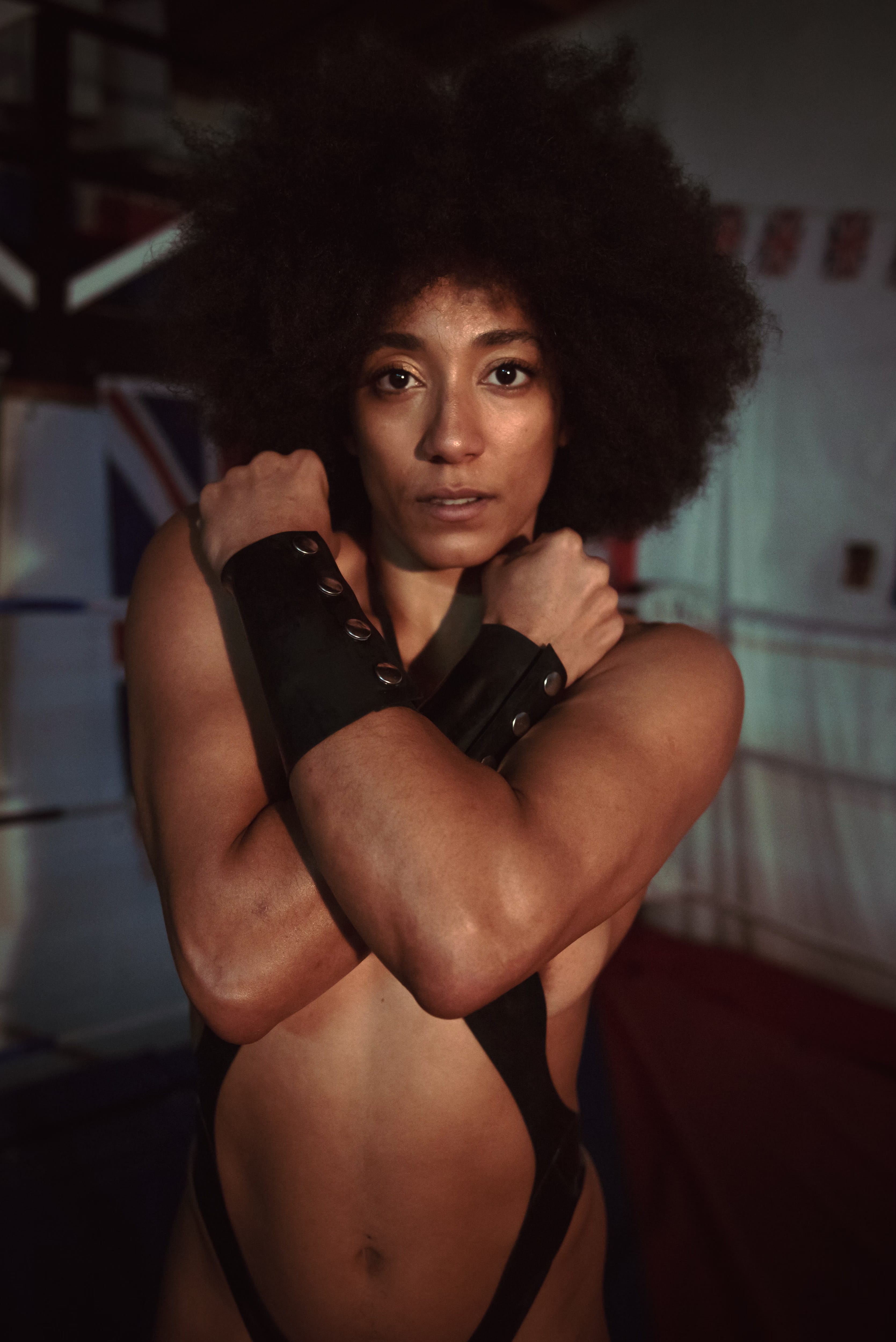
The last time I met VeVe Lane on the mats, it was to have our third competitive match. I was filming it for my clips store, and as I’d bought my British flag bikini to grapple in, I thought it would be fun for Lane to wear something appropriately Americana. While she didn’t have a flag bikini, she did have her Wonder Woman two-piece — and WW is, after all, as American as apple pie.
I’ve never known much about Wonder Woman, but Lane’s friend, who was there to watch the match, did know quite a bit — more specifically, about her origin story. He introduced me to a film that, for some strange reason, I had never heard of: Professor Marston and the Wonder Woman. The film details the lives of Professor Marston, a Harvard psychologist and the creator of Wonder Woman, his wife Elizabeth Holloway Marston, and their student who was to become their lifelong companion, Olive Byrne.
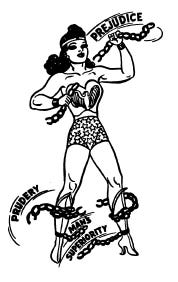
Both women served as inspiration to Wonder Woman herself. Not only was Marston inspired by these two strong, independent and intellectual women, but also by the world of BDSM. That’s right — Wonder Woman’s lasso of truth is an amalgamation of his sensual interest in bondage and his academic interest in psychology.
There is a scene in the movie where, during an evening in a fetish club, Olive emerges clad in a burlesque leotard, high heels, and a demure yet sparkling expression, her erotic thirst bubbling beneath her shy surface. She clutches at bondage ropes expectantly.
With astonishment, I felt the scene actually bringing tears to my eyes.
I was curious about why I was so moved by the scene. Nowadays, we see women in various states of undress absolutely on a daily basis. Regardless of whether we seek it out, we cannot help but admit that, like everything else, we have been desensitised. But I couldn’t help but feel that, in this moment, Olive must have sensed an almost overwhelming feeling of freedom.
The social expectations and demands of her sexual permissivity and submissiveness dissolve with the acknowledgment that she has, in fact, sexual agency and authority. Many glass ceilings would have existed for her in her professional life as a woman during this particular time period. In addition, women have long experienced a crucial disenfranchisement — the hyper-regulation of our bodies, our sexualities, and expressions of our strength and power.
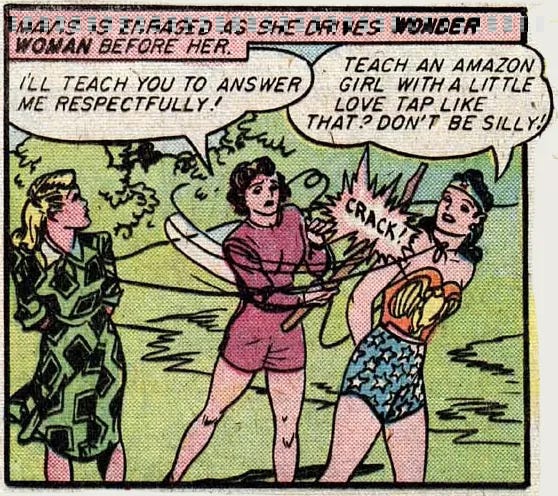
In this outfit — the prototype of Wonder Woman’s costume — the boundary between deviant and a woman expressing her desire falls away. The true power of her tiny costume becomes a metaphor for the latent human desire to break free from the bondage of moral frigidity and to shed the irrational prudishness surrounding the human body and female sexuality.
And yet, the story of Wonder Woman is not just one of female empowerment through physical appearance.
Marston was clearly a forward thinker who respected women, both as colleagues and mentors. In his 1928 book Emotions of Normal People, he cites female psychologist Dr Edith Spaulding as a mentor of “able leadership” — no small thing in that period. He worked closely with his wife Elizabeth and Olive, their work in psychology intersecting in profoundly personal ways, an expression of which was Wonder Woman herself.
Perhaps his feminism is further proven by the fact that when he fell terminally ill, he commissioned Joye Hummel Murchison, one of his psychology students, to ghostwrite for the comic. As we can see from the comic below, Joye follows this trajectory of truth-seeking, justice, and feminine strength.
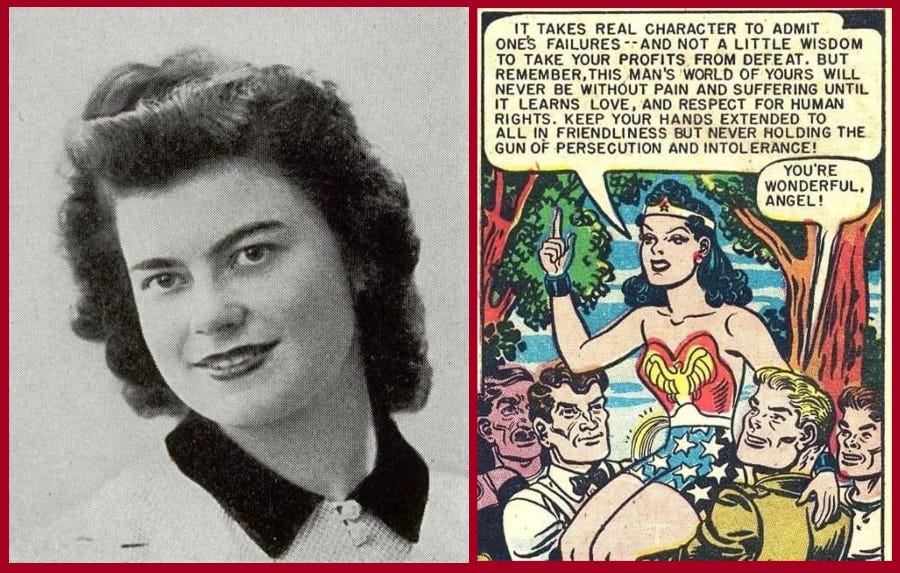
Yet what is most fascinating about Wonder Woman isn’t just how a symbol of feminist liberation was born from a submissive’s latent fetishistic fantasies — although those aspects are crucial to understanding her as an avatar of freedom. It’s that while her existence was formulated from unconventionality, she is in fact a defender of social convention and conformity as much as she is a resistance to these same norms.
Wonder Woman is, after all, all woman. She is as feminine as she is strong, as beautiful as she is determined, as loving and altruistic as she is decisive and commandeering. This was absolutely intentional and stated by Marston himself:
“It seemed to me, from a psychological angle, that the comics’ worst offense was their blood-curdling masculinity… The obvious remedy is to create a feminine character with all the strength of a Superman plus all the allure of a good and beautiful woman. This is what I recommended to the comics publishers.”
— William Marston, The American Scholar
Wonder Woman blends into “normal” life — a benevolent, extraterrestrial force in a society that is constantly crumbling at the seams. In a world trapped in a never-ending series of crises, it is only Wonder Woman, in her dazzling uniform of bodysuit, bondage rope and bangles, who can save the day.
Born to the Amazons on a planet ruled by Aphrodite, the Goddess of Love, Wonder Woman dons the role of Diana Prince when among civilians. In everyday clothing, she walks among normal men and women, concealing her true identity.
Yet Wonder Woman is not judgemental of regular civilians. Despite representing everything that 1940s America chastised — female independence, resistance to social norms, revealing clothing — she does not abhor traditional roles for others. Instead, she defends them, whilst simultaneously preserving her fierce independence.
Wonder Woman’s mission is to protect the status quo, not destroy it. Born during World War II, her purpose is to defend American values while urging humanity toward genuine humanitarianism and compassion. It is not helpful to hate the society we live in, particularly when it affords us freedoms of speech, self-determination, and political and religious expression.
When we consider societies in which women and political dissenters are denied agency — such as those living under the Islamic Republic in Iran, or Afghan women and their male supporters under the Taliban — we can see that a figure like Wonder Woman can only exist within a social order that permits, however imperfectly, the possibility of freedom and human agency.
The social mores perpetuated within normative democratic societies must not be taken for granted. It is from these conditions that the groundwork for moral and ethical philosophies is laid. It is those very philosophies that empower us to challenge the status quo when necessary, as well as the social inequalities that inevitably arise in a world shaped as much by human error as human refinement.
No society is perfect, but so long as individual autonomy can be exercised, the means to change the world for the better is within our hands. As long as we are able to employ and enjoy personal and collective autonomy, we must be very careful to speak truth to power, and recognise our privilege with purpose, both at the individual level, and that of the state.
The greatest threat to freedom does not always come in the form we expect. In order to defend our freedom, we must be able to acknowledge when and where we already have it. There is no greater display of this than in our ability to subvert, to deviate, and still exist within the framework of normative society.
In this day and age, perhaps our biggest threat to democracy — and the root of the most insidious forms of social dysfunction — is our inability to understand that deviance and subversion exist as an antidote, not merely an antithesis, to social function.
In the same way that our heroes walk amongst us in civilian clothes, so too do the truest threats and the greatest evils. We must be able to look at ourselves and one another with honesty, critical thinking, and compassion.
As they say: real heroes don’t wear capes. They look just like you and I.